Customer Server Memory DRAM Chip Replacement: From Fault Diagnosis to BGA Rework
2026-04-03 · ResolderWorks
The Full Repair Process — 9 Detailed Steps
The repair follows nine stages, from diagnostics to final verification.
Step 1. Memory Tester Diagnostics
The module is installed in a dedicated memory tester to perform read/write tests across all memory cells. By identifying which address ranges produce errors, we narrow down which DRAM chip is likely at fault.
[Memory tester diagnostics]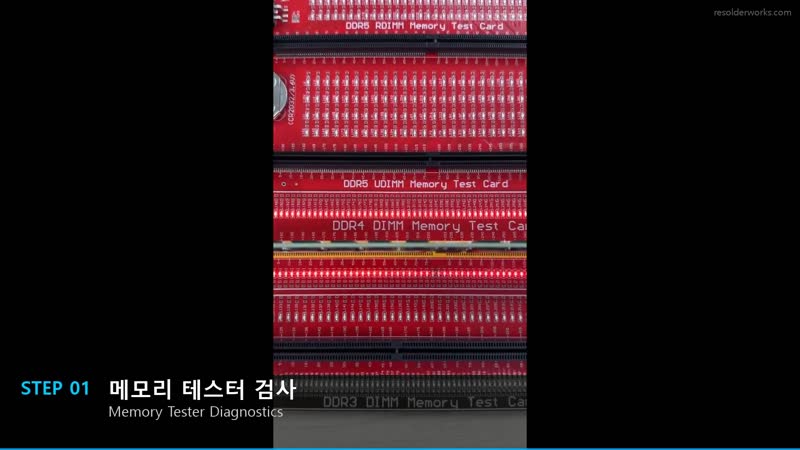 Running full-cell read/write tests on the dedicated memory tester
Step 2. Thermal Imaging Fault Detection
With the memory module powered on, we use a thermal imaging camera to examine the heat signature of each DRAM chip. Faulty chips often show abnormal thermal patterns compared to healthy ones.
In this repair, one DRAM chip showed abnormal heat generation.
[Thermal imaging fault detection]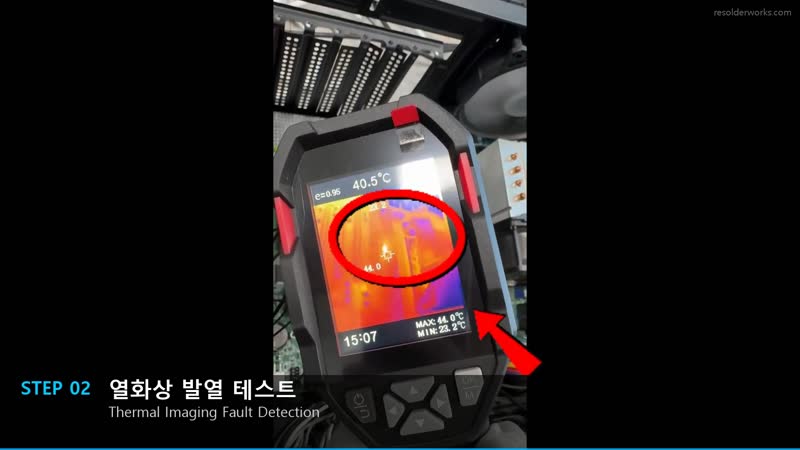 Thermal camera identifies a chip with abnormal heat output
Step 3. Chip Desoldering
To remove the confirmed faulty DRAM chip, we heat the surrounding area with a hot air gun. Proper temperature is maintained until the BGA solder balls fully melt, while heat-shielding tape protects neighboring components from excessive heat.
[Chip desoldering]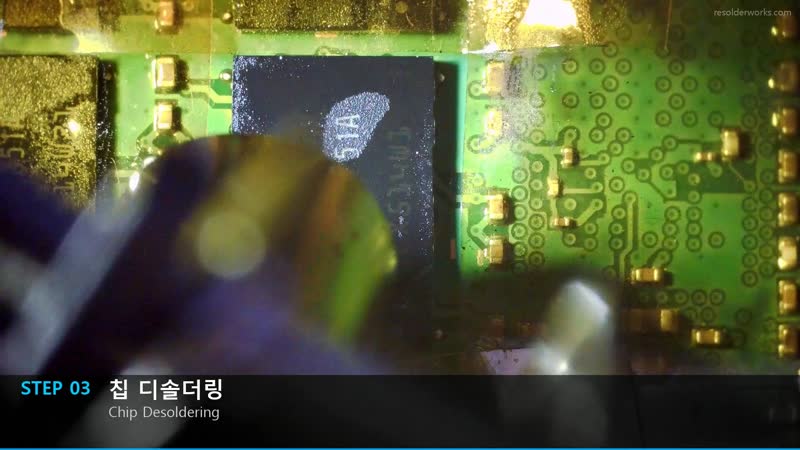 Heating the faulty chip area — neighboring components protected with heat-shielding tape
Step 4. Damaged Chip Removal
Once the solder melts, the faulty chip is carefully separated from the board. We lift it vertically to avoid damaging the PCB pads, then inspect the pad condition to confirm the next steps can proceed.
[Damaged chip removal]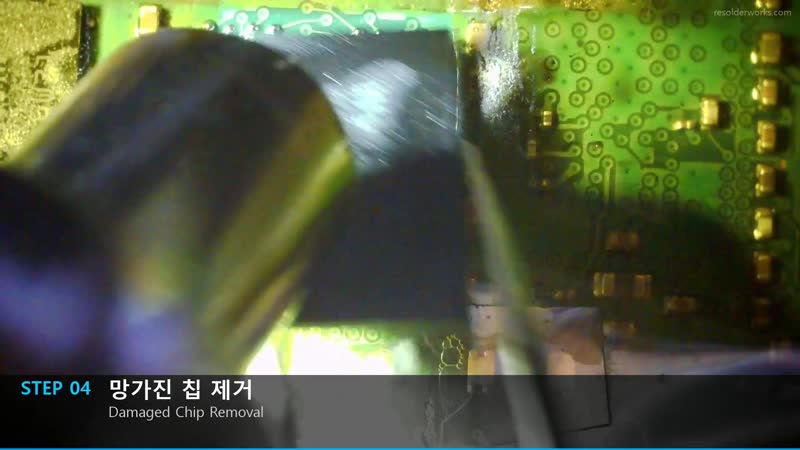 Faulty chip removed — inspecting PCB pad condition
Step 5. Donor Chip Reballing
A donor (functional) chip is prepared by attaching new solder balls through the reballing process. A reballing stencil is aligned to the chip, solder balls are placed, and heat is applied to form uniform BGA solder balls.
[Donor chip reballing]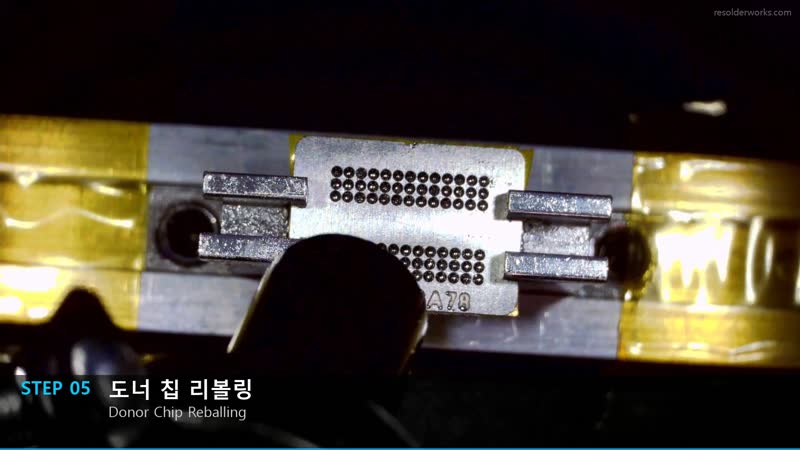 Forming new solder balls using a reballing stencil
Step 6. PCB Flux Application
Flux is applied to the PCB pads on the target memory module. Flux aids solder ball-to-pad bonding during reflow and prevents oxidation — it's an essential material. Applying the right amount evenly is critical.
[PCB flux application]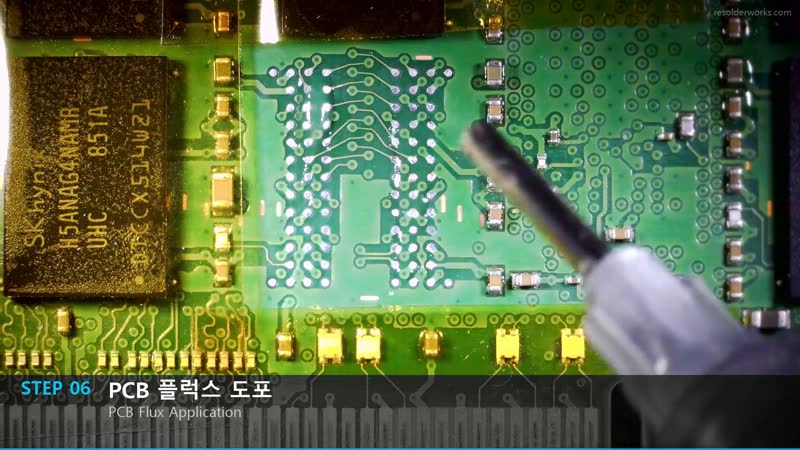 Applying flux to the target memory PCB pads
Step 7. Donor Chip Alignment
The reballed donor chip is placed onto the precise location on the PCB. Using the pin 1 marker as reference for orientation, the chip is aligned under a microscope so that every solder ball matches its corresponding pad exactly.
[Donor chip alignment]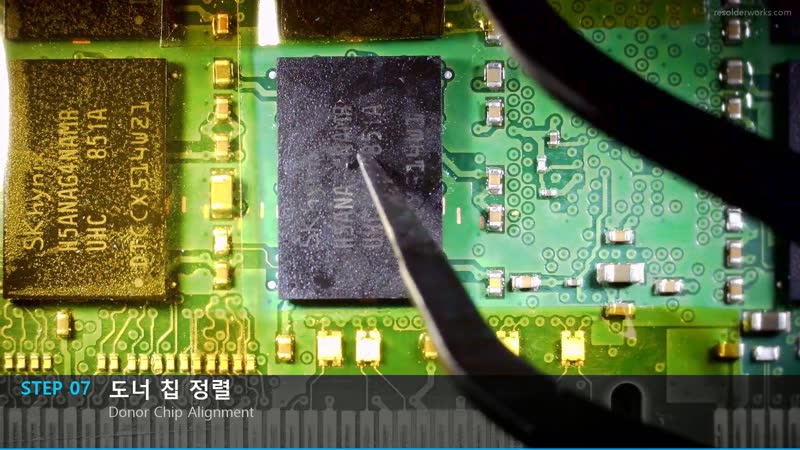 Precision alignment using the pin 1 marker under a microscope
Step 8. Reflow Soldering
With alignment confirmed, reflow is performed using a hot air gun. Following a controlled temperature profile — preheat, main heat, and cooling — the solder balls melt and form complete bonds between the chip and PCB pads.
Temperature and timing are precisely managed to prevent thermal damage to both the chip and the board.
[Reflow soldering]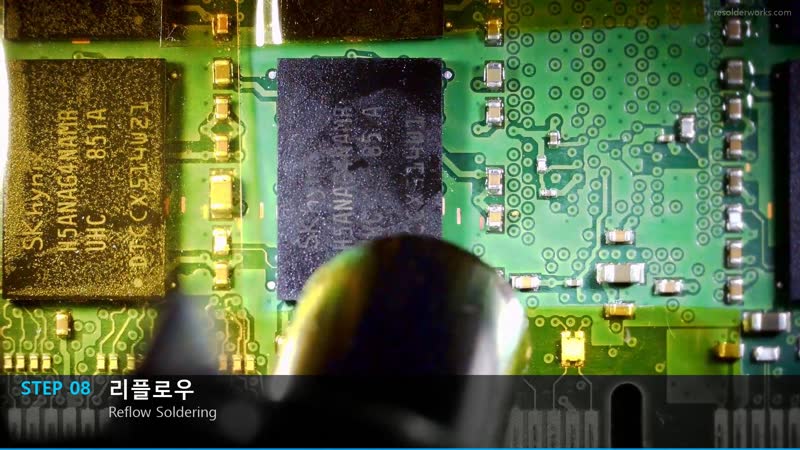 Reflow in progress — controlled preheat, main heat, and cooling cycle
Step 9. Rework Verification
After reflow, visual and microscope inspection confirm the soldering quality. We check for solder bridges, cold solder joints, and other defects, then re-test on the memory tester to verify normal operation before completing the repair.
[Rework verification complete]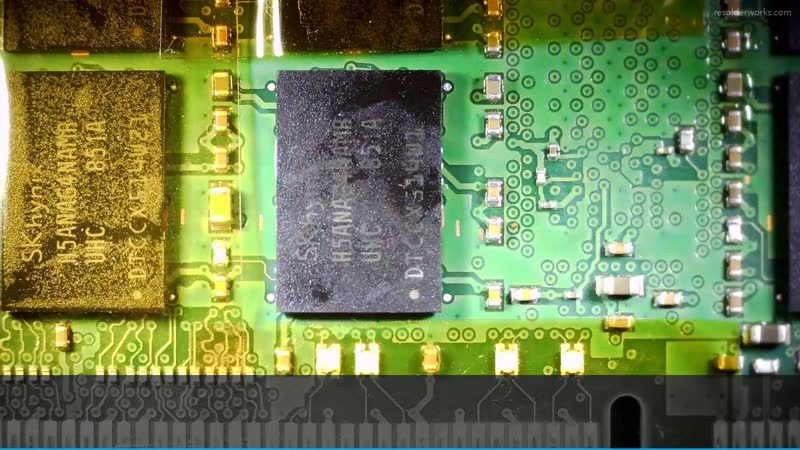 Memory tester re-test confirms normal operation — repair complete
Diagnostic Equipment Makes the Difference
The most common cause of failed DRAM chip replacement repairs is "replacing the wrong chip." Guessing based on symptoms alone without a memory tester, or working without thermal analysis, can result in the same errors persisting even after replacement.
ResolderWorks owns dedicated memory testers and thermal imaging cameras, allowing us to accurately pinpoint the faulty chip before performing any replacement.
ResolderWorks Repair Services
- Server memory DRAM chip replacement (DDR3 / DDR4 / DDR5)
- Memory tester + thermal imaging camera precision diagnostics
- Professional BGA reballing & rework
- Bulk repair available for enterprises and data centers
- Post-repair re-testing included
ResolderWorks handles the entire process in-house — from diagnostics through repair to final verification. If you need server memory repair, reach out below.
Need Server Memory Repair?
We specialize in DRAM chip replacement and BGA rework for DDR3 / DDR4 / DDR5 server memory modules. Bulk repair for enterprises and data centers is also available.